Late Warring States period/Gold and turquoise
Gold earrings inlaid with turquoise, Warring States period
Three tiers of pendants linked by small rings and interspersed with tiny gold beads.
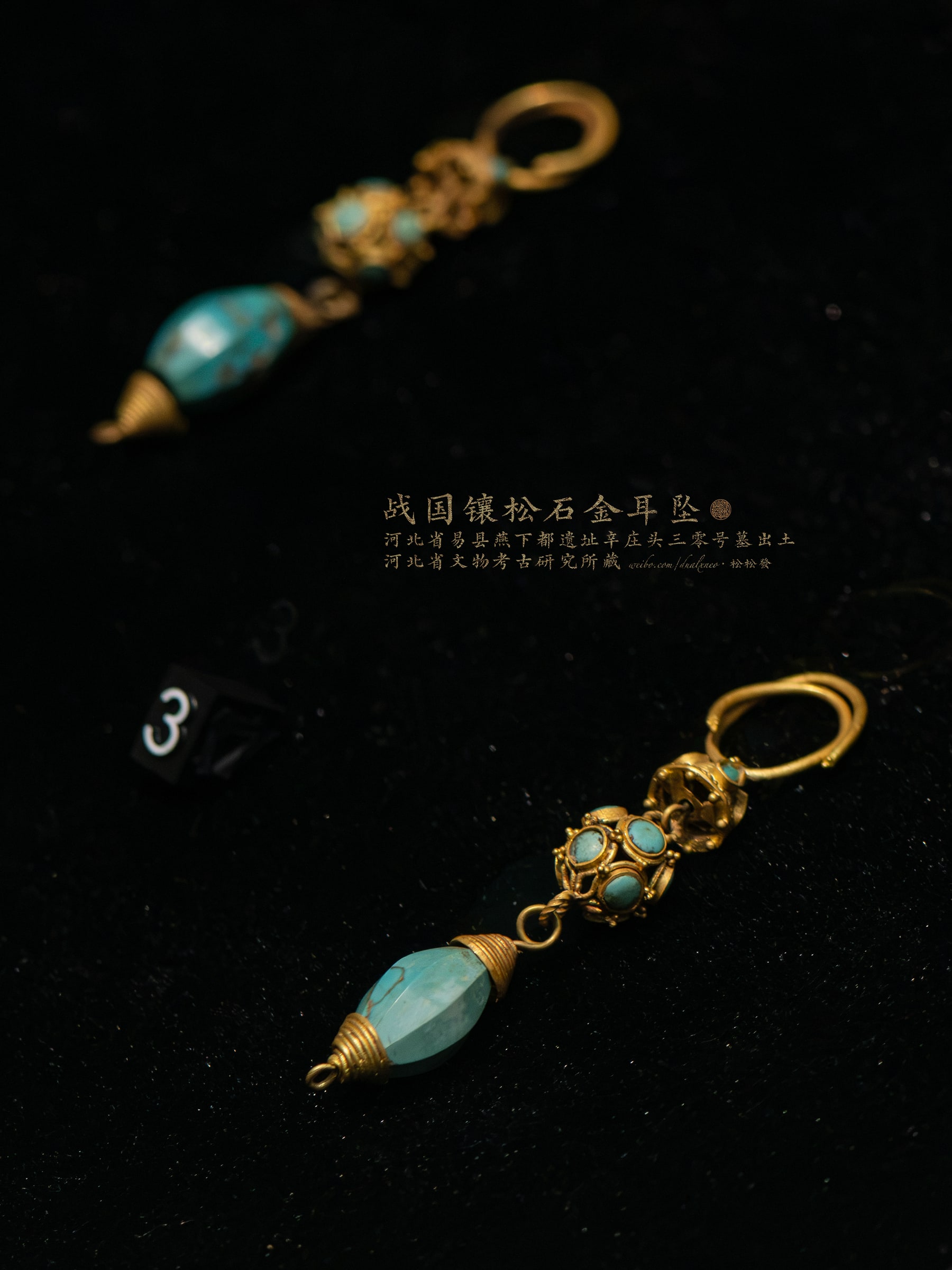
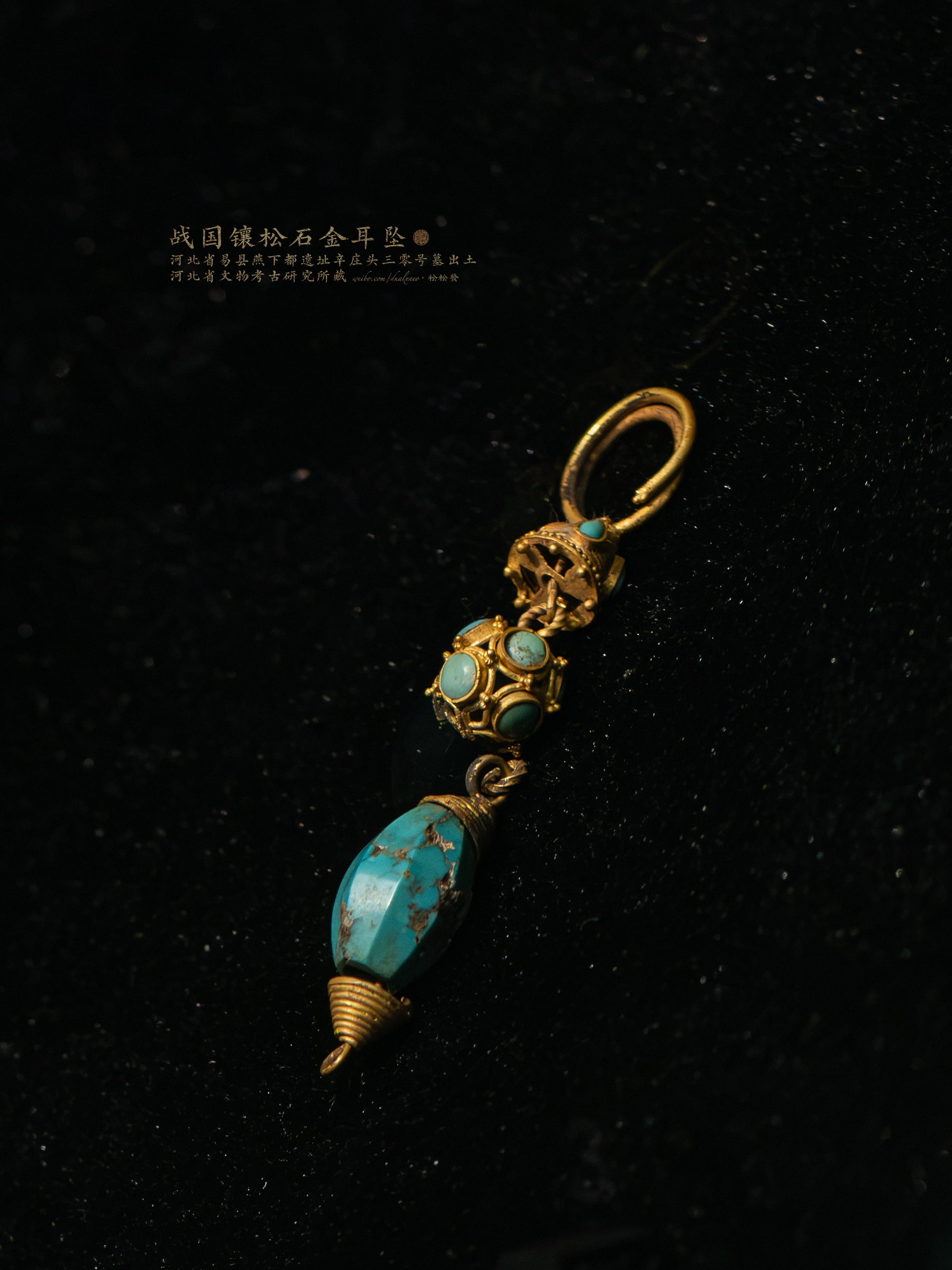
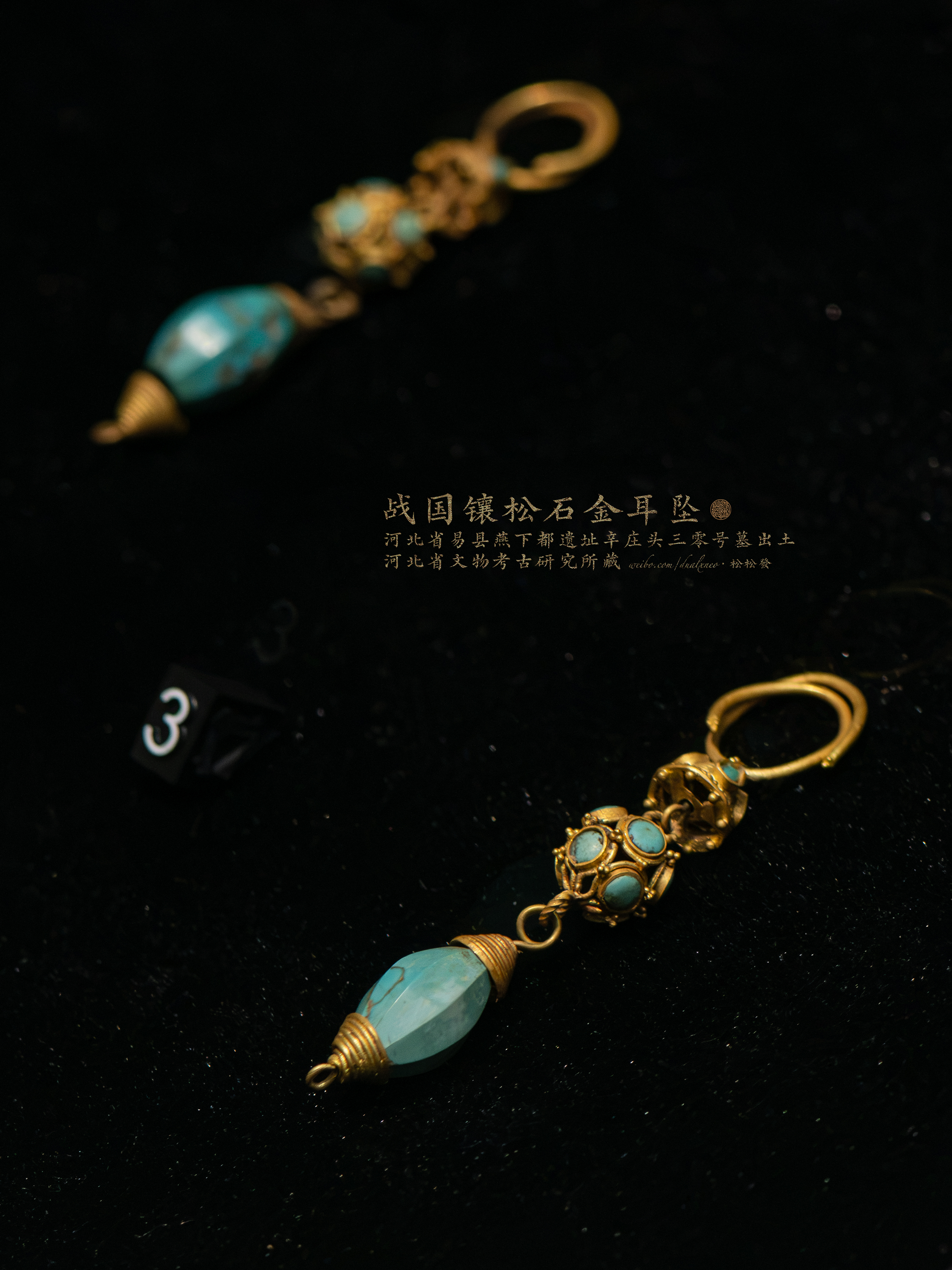
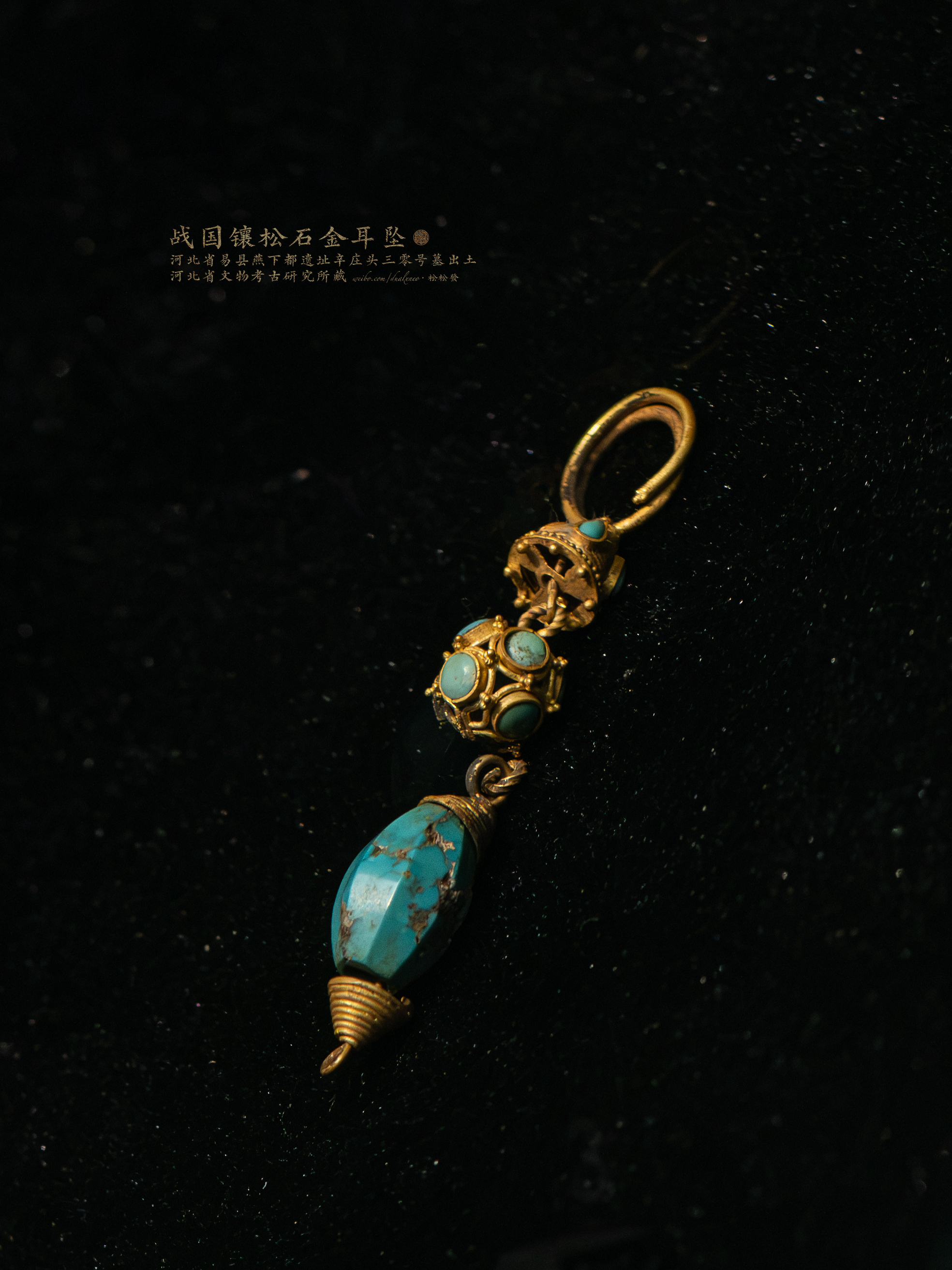
Image Sharing & Citation
Photos are shared under CC BY 4.0: free to download, modify, and use commercially with credit and a link to this page. This license applies to photos only; object descriptions and articles are subject to standard citation practices.
Cite this object record. The access date uses your browser’s current date.
- Name
- Gold earrings inlaid with turquoise, Warring States period
- Period
- Late Warring States period
- Material
- Gold and turquoise
- Collection
- Hebei Provincial Institute of Cultural Relics and Archaeology
- Findspot
- Excavated from Tomb 30 at Xinzhuangtou, Yandu (the Lower Capital of Yan), Yi County, Hebei
- Text by
- 黄松涛(松松發文物君) / Huang Songtao
- Photography
- 黄松涛(松松發文物君) / Huang Songtao
- Photography equipment
- Nikon D850
Description
Steppe-style gold earrings of the late Warring States period, inlaid with turquoise. A gold wire bent into an open hoop forms the upper section, from which three tiers of pendants hang, linked by small rings. The upper pendant is bell-shaped, with openwork and turquoise inlays, and small gold beads along its lower edge. The middle pendant is approximately spherical, with an openwork gold-wire frame set with round turquoise inlays and small gold beads between the settings. The lowest pendant is an elongated, faceted turquoise drop, with conical caps formed from coiled gold wire at both ends and a small ring at the tip.
Excavated from Tomb 30 at Xinzhuangtou, at the site of Yandu (the Lower Capital of Yan), Yi County, Hebei. In the collection of the Hebei Provincial Institute of Cultural Relics and Archaeology. Yandu records four earrings, forming two pairs of the same design, from this tomb; specimen XZHM30:38—1 measures 6.2 cm in total length.
The tomb had been robbed and burned at an early date, but still yielded pottery ritual vessels imitating bronze forms, together with burial goods made from bronze, lead, gold, silver, bone, antler, jade and other stones. The assemblage is predominantly associated with Yan culture, while also incorporating elements from the northern steppe and northeastern regions, showing pronounced cultural exchange along the northern frontier.
References
- Hebei Provincial Institute of Cultural Relics (ed.), 《燕下都》 (Yandu), 2 vols., Wenwu Press, August 1996.
- Hebei Museum (ed.), 《金银曜烁 美熠四方:京冀晋豫陕五省市金银器展》, August 2021, entry “嵌绿松石金耳坠”.
Published