Early Spring and Autumn period/Gold
Tiger-shaped gold ornament
An early Spring and Autumn period gold tiger from tomb M257 at Shijia cemetery in Gansu. Li Ling interprets it as a fitting for a quiver.
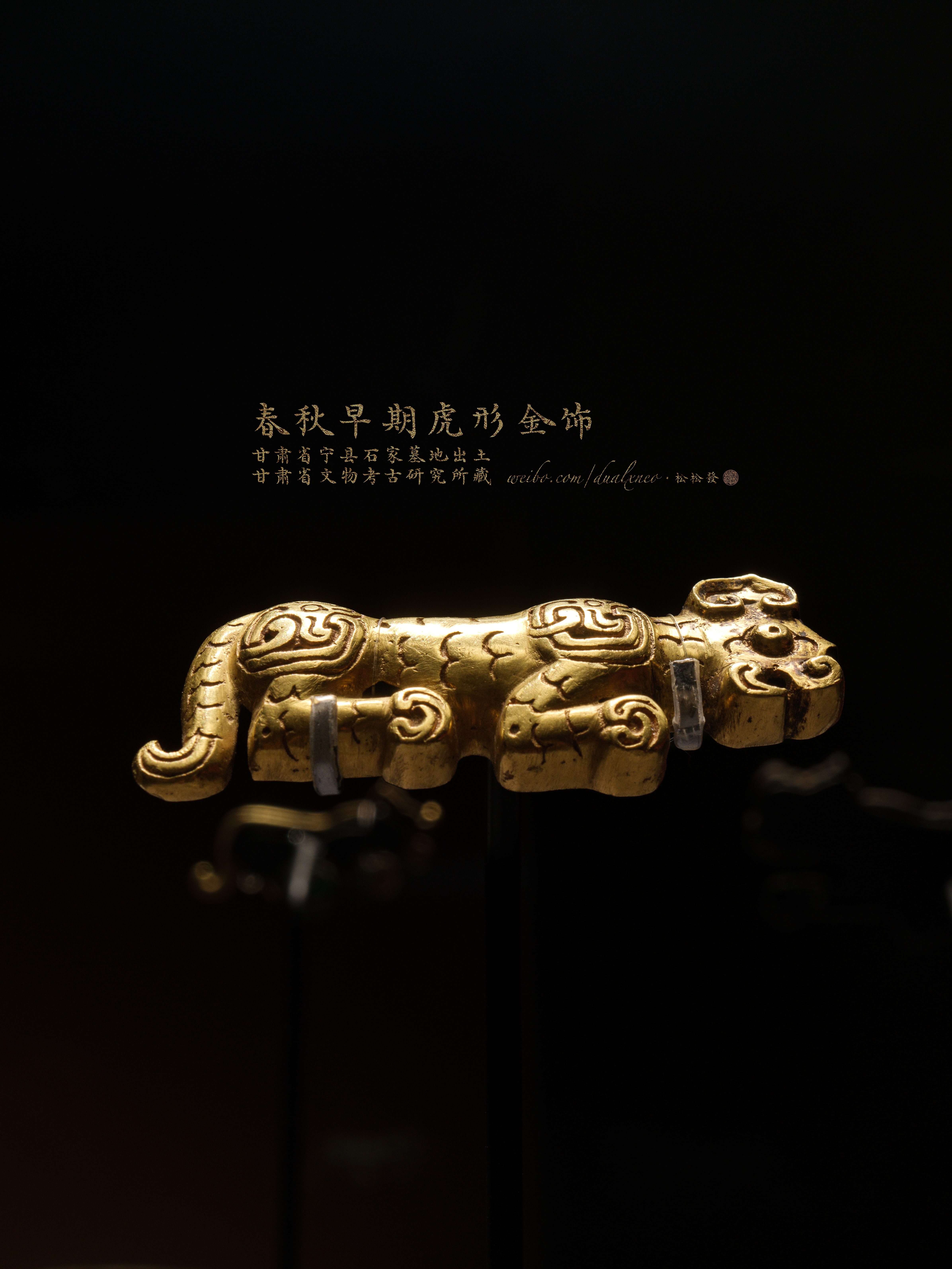
Tiger-shaped gold ornament, early Spring and Autumn period. Excavated from tomb M257 at Shijia cemetery.
Photography: 黄松涛(松松發文物君) / Huang Songtao · CC BY 4.0
- Name
- Tiger-shaped gold ornament
- Period
- Early Spring and Autumn period
- Material
- Gold
- Dimensions
- Unknown
- Collection
- Gansu Provincial Institute of Cultural Relics and Archaeology
- Findspot
- Tomb M257, southern area of Shijia cemetery, Zaosheng, Ning County, Qingyang, Gansu, China
- Text by
- 黄松涛(松松發文物君) / Huang Songtao
- Photography
- 黄松涛(松松發文物君) / Huang Songtao
Description
This gold ornament depicts a tiger in profile with its limbs drawn beneath its body. The elongated torso has a slightly concave back. The head projects forward, with a raised round eye, an upright peach-shaped ear, an open mouth and a curling snout. The forelimbs and hind limbs are tucked beneath the belly, ending in hook-like curls. The long tail drops down before curling outward and upward at its tip. Raised kui-dragon motifs decorate the shoulder and haunch, while rows of short curved lines form tiger markings across the body, limbs and tail.
Li Ling interprets the piece as an ornament attached to a quiver—a container for arrows—and regards such fittings as one of the most distinctive types of weapon-related ornament from Shijia cemetery.
It was excavated from tomb M257 in the southern area of Shijia cemetery, at Zaosheng in Ning County, Qingyang, Gansu. In the excavators’ published chronology, M257 belongs to Phase I, dated to the early Spring and Autumn period. The ornament is held by the Gansu Provincial Institute of Cultural Relics and Archaeology.
References
- 王永安、孙锋、杜博瑞:“交流、变迁与融合——甘肃宁县石家及遇村遗址考古新发现”,《中国文物报》2020年9月4日第8版。
- 李零:《十二生肖中国年》,生活·读书·新知三联书店,2020年,参见图7-1。
- 李零:“阅读新发现(四题)”,《文物》2025年第11期,参见图八第3件及注13;该注引《陇原余周——甘肃宁县石家墓地出土文物集萃》(文物出版社,2024年)第130页。